LSFG cannot measure absolute flow velocity such as an average speed of a certain number of millimeters per second.
With LSFG, it is possible to compare temporal changes in blood flow values at the same site.
For example, by measuring and comparing blood flow values before and after surgery, it is possible to confirm the effectiveness of the procedure.
In LSFG, veins—which have slower flow through larger-diameter vessels—show higher blood flow values than arteries, which have faster flow through narrower vessels.
In arteries with thick vessel walls, the laser does not penetrate to the vessel interior, so stationary scattering particles (vessel tissue) are reflected, resulting in lower blood flow values.
Conversely, in veins with thin vessel walls, the laser penetrates to the vessel interior, so moving scattering particles (blood cells) are reflected, resulting in higher blood flow values.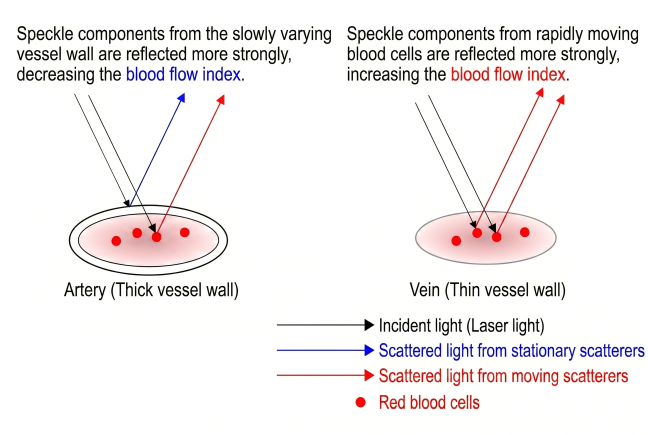
Due to these circumstances,
arguments such as "LSFG cannot numerically compare arterial and venous blood flow," or
"The retinal blood vessel blood flow is 40, and the choroidal blood vessel value is 10, so the choroidal flow speed is 1/4 of the retinal vessel speed"
cannot be made. Please note that "what can be done is to compare changes in blood flow at the same site."
Select your language