


Living tissue can be regarded as a collection of numerous scattering particles. As shown in the figure below, consider a model in which laser light is scattered by particles randomly distributed in space, and we will explain why speckle patterns occur in this process.
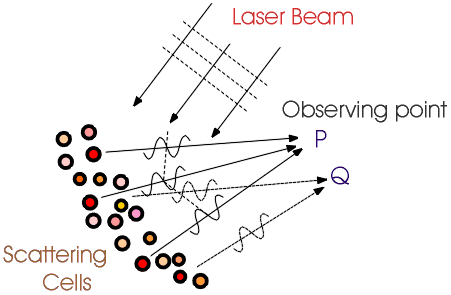
If the numerous scattered wavefronts arriving at a certain point P on the observation plane from these particles happen to interfere in phase, they reinforce each other and that point becomes bright.
However, at another point Q, the optical paths of the scattered wavefronts arriving from each particle form a different combination, so they may become out of phase and cancel each other out, making that point dark.
Recall how two wavefronts interfered in Young's interference experiment. Now extend this and imagine what happens when a very large number of wavefronts interfere randomly.
Since the positions of the scattering particles have no regularity whatsoever, whether a given point becomes bright or dark cannot be known until the interference actually occurs—and the same is true for neighboring points. In other words, whether a point becomes bright or dark follows a stochastic process.
The interference pattern formed in this way does not become a regular fringe pattern but rather a random speckle pattern. If all scattering particles are stationary, this pattern also remains stationary.