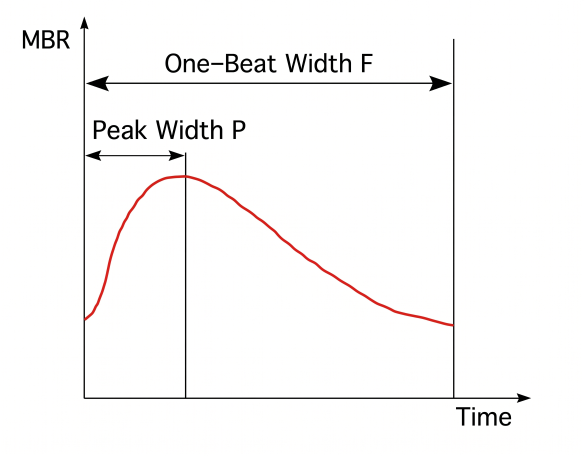
ATI indicates where within one heartbeat the blood flow peak occurs at the observation point, and typically shows a value of approximately 25–30%.
In peripheral regions where the pathway is longer and it takes more time for the blood flow peak to arrive, ATI becomes higher. Therefore, ATI becomes higher in cases such as venous regions where the waveform peak position is delayed compared to arteries.
Additionally, when the heart rate is high and the period of one heartbeat is short, ATI also becomes higher.
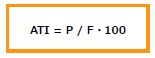
When expressed as a percentage, the value ranges from 0 to 100, but in some cases (such as Cobitos), it may be expressed as a decimal from 0 to 1.0, such as 0.3.
ATI stands for "Acceleration Time Index."
ATI was originally called "Peak," but the name was changed to "ATI" to make it easier to use in English-language publications.
While other indices such as Skew and BOS quantify the shape of the entire waveform,
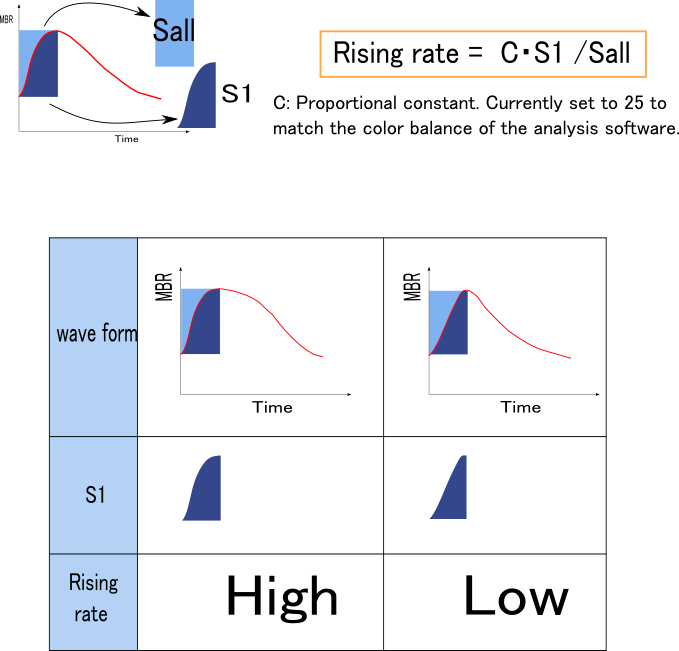
Rising Rate and Falling Rate focus on the ascending and descending portions of the heartbeat waveform, respectively.
In a word, Rising Rate is a quantification of how mild the blood flow rise is. A healthy heart produces a mild blood flow rising waveform, but in conditions such as heart failure, the waveform appears to rise steeply. Therefore, Rising Rate increases when the waveform is mild. It appears to be a value that is not dependent on age.
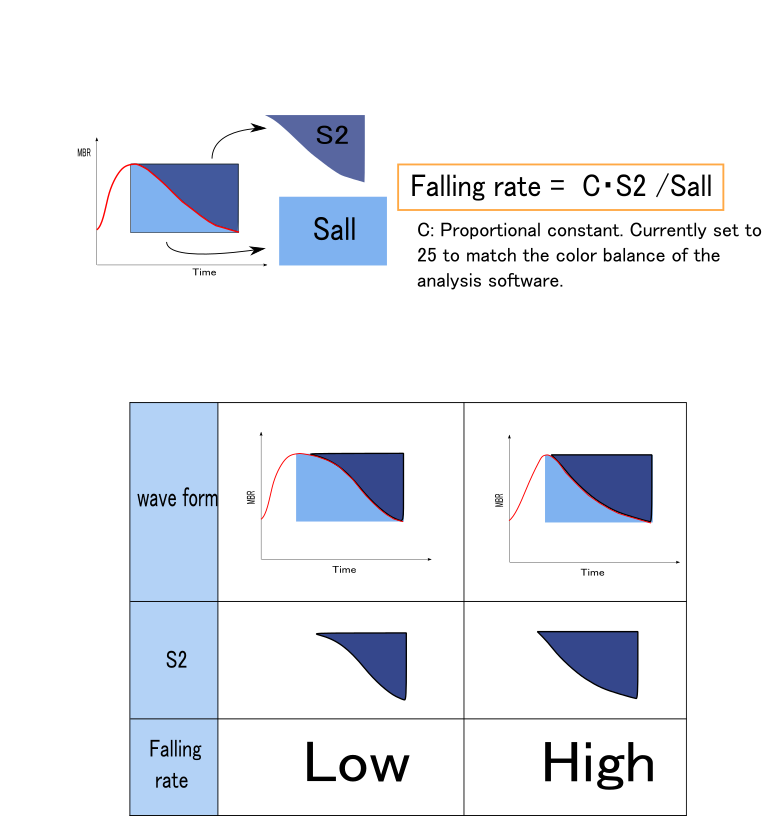
On the other hand, Falling Rate focuses on the waveform after the peak and, in a word, represents how quickly the blood flow recedes. As age increases, the peripheral vessels decrease, and the blood flow that filled the peripheral side quickly subsides like a receding tide. In this case, Falling Rate becomes higher. Conversely, when there is an abundant peripheral vascular bed, the flow recedes slowly and blood flow transitions gradually to the diastolic phase. For this reason, Falling Rate correlates well with age and shows a positive correlation.
As shown in the figure below, the ratio of the areas before and after the peak of the waveform is represented.
Like Skew, this index becomes larger when the rise/fall is rapid and smaller when it is gradual.
Rising Rate
Falling Rate
Recent Reports
- Tomoaki Shiba, Mao Takahashi, Tadashi Matsumoto and Yuichi Hori
Pulse Waveform Analysis in Ocular Microcirculation by Laser Speckle Flowgraphy in Patients with Left Ventricular Systolic and Diastolic Dysfunction
Journal of vascular research, 55(6), 329-337, doi:10.1159/000494066, 2018.