


When LD output is increased, the values tend to become slightly higher, particularly in vessel areas.
In tissue blood flow areas, the light is sufficiently scattered, so the values do not change much unless the LD output is extremely reduced.
This is thought to be due to the following reasons.
- "Increased light scattering events due to increased light intensity"
When LD output is increased, light penetrates deeper into the measurement site.
If the tissue reached scatters light well, multiple scattering occurs repeatedly, reducing coherence and consequently lowering the speckle contrast.
Since MBR values are the reciprocal of contrast, when contrast decreases, the values increase, resulting in slightly higher values than the actual blood flow velocity as described above.
The issue is that the degree of this increase depends on the scattering characteristics of the tissue.
Therefore, during measurement, please ensure the laser level is approximately the same as when the previous measurement was taken.
Tip: By double-clicking the measurement data from the previous session in the clipboard, you can open the measurement screen with the same laser level as the previous measurement.
- "Detection limits exist when digitizing image signals"
This is a problem that occurs when LD intensity is set extremely high or low. The speckle signal received by the CCD camera is converted into integers from 0 to 255 and stored in memory.
At this point, even if light brighter than 255 enters, the value is stored as 255.
This state is commonly called signal clipping (or saturation), and when displayed as a grayscale image, it appears as an entirely white image.
When each pixel becomes mostly 255, the contrast decreases (and the reciprocal blood flow value is displayed higher).
When strong specular reflection is accidentally captured, such as from a contact lens, a bright red sun-like artifact appears in the blood flow map.
Conversely, if the light intensity is too low, 4.1 is stored as 4, and 4.9 is also stored as 4. Since the decimal information is lost, the statistical error increases, value variation increases, and the image becomes grainy.
To avoid these issues, please adjust the LD level so that the area you want to measure appears approximately green (around a value of 100) in the LD intensity map.
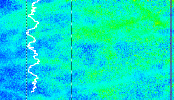
LD intensity map adjustment example
When you want to observe optic disc and choroidal blood flow simultaneously, the light intensity levels differ significantly, so it can be difficult to decide which one to match.
For reference, if you take one shot at each different level, you will not later regret that the laser level for the retina outside the optic disc was too dark.