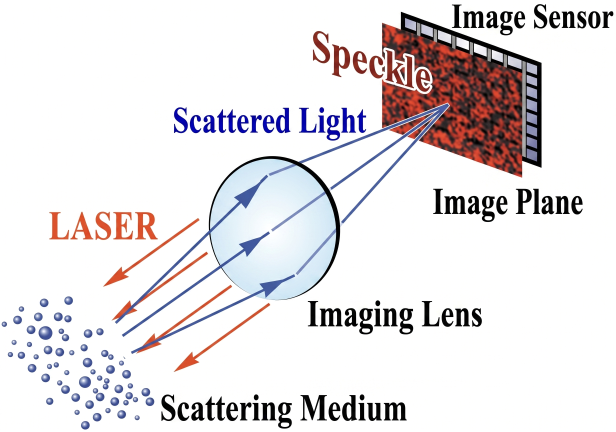
Scattering particles inside a living body, typically represented by blood cells, are almost always in motion, so the interference conditions at every point on the observation plane change from moment to moment. In fact, speckles generated from living tissue change their pattern at an extremely rapid rate. As shown in the figure below, when the observation plane is at the image plane of the living body surface, a point on the living body and its corresponding image point are linked in a one-to-one relationship. That is, the rate of change of speckle at a given image point is determined by the migration speed of scattering particles (in this case, blood cells) in the vicinity of the corresponding point on the object, and the former is approximately linearly proportional to the latter. If the blood flow velocity at a given point on the living body surface decreases, the speckle fluctuation at the corresponding point on the image plane becomes slower. Therefore, if we calculate the temporal rate of change of the speckle at each point on the image plane and display it as a map, that directly represents a map of blood flow velocity.
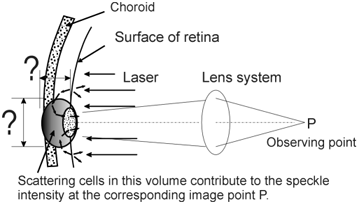
The question of what range of scattering particle movement contributes to the light intensity fluctuation at a given point on the image plane is extremely complex. Organizing what has been understood so far, the following two factors need to be considered.
1 No matter how sharp an imaging system is, it cannot form a perfect point image of a point object due to aberrations and diffraction effects. Conversely, this means that wavefronts scattered from a small area on the object surface overlap at a point on the image plane. This is related to the question of how thin a blood vessel's blood flow the LSFG system can measure.
2 As the laser penetrates deeper into the living body, it diffuses and is absorbed, but the scattered wavefront emerging from a point on the living body surface toward the imaging system has traveled various paths within the body. Some exit from a very shallow layer near the surface without much scattering, while other wavefronts exit after penetrating quite deep. The latter, having wandered around extensively, become considerably weakened, resulting in only faint light. If we could eliminate the strong scattered light coming from the surface and capture only the weak scattered light coming from deep within, it seems we could observe deep-layer blood flow maps. However, this is quite difficult and remains one of our important research themes.