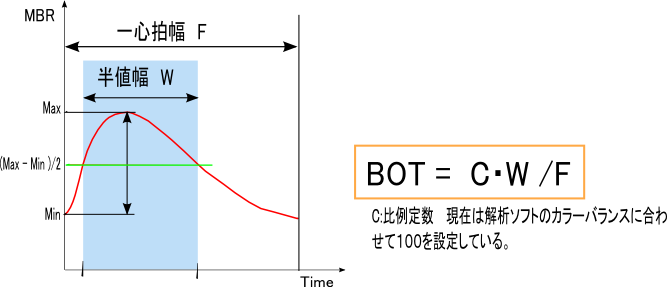
In a word, it represents the duration (proportion) of blood flow. Another characteristic is that it indicates the degree of progression of arteriosclerosis.
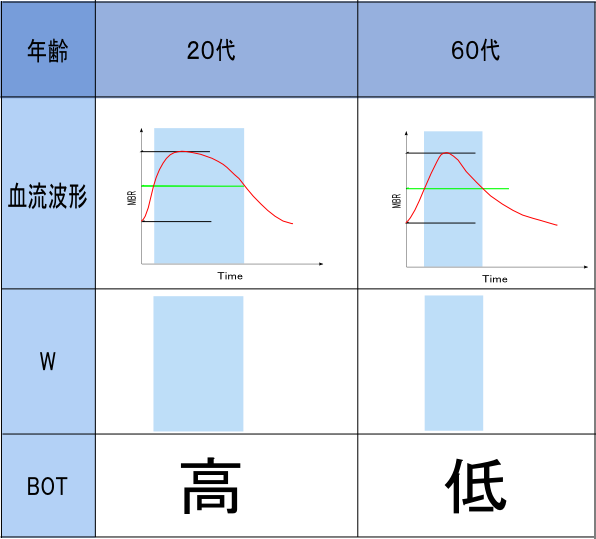
When a blood vessel dilates, it expands with elastic force. A flexible blood vessel has abundant elasticity and therefore stretches smoothly, contracting gently. → The duration of blood flow is long (BOT is high).
On the other hand, in a blood vessel where arteriosclerosis has progressed, the vessel is stiff, so when blood pressure is applied, the vessel tries to expand rapidly, but because it is stiff, it contracts immediately. → The duration of blood flow is short (BOT is low).
A high BOT suggests elastic blood vessels with slow progression of arteriosclerosis, while a low BOT may indicate that arteriosclerosis has progressed.
BOT indicates the proportion of time within one heartbeat during which the blood vessel is dilated, so it better reflects the state of arteriosclerosis. For this reason, the BOT of the entire optic nerve head shows a negative correlation with age.
[References]
- Tomoaki Shiba, Mao Takahashi, Yuichi Hori and Takatoshi Maeno
Pulse-wave analysis of optic nerve head circulation is significantly correlated with brachial ankle pulse-wave velocity, carotid intima media thickness, and age
Graefe's Archive for Clinical and Experimental Ophthalmology, doi: 10.1007/s00417-012-1952-5, 2012.
On the other hand, healthy individuals who exercise regularly tend to have a lower resting heart rate and better oxygen exchange efficiency.
BOT, which represents the proportion of blood flow duration within one heartbeat, also appears to be relatively lower in those who exercise compared to those who do not. → BOT is low (however, it is not as low as that caused by the progression of arteriosclerosis, so when considering the degree of arteriosclerosis progression, it is necessary to make a comprehensive judgment using both heart rate and BOT.)
BOT (Blow Out Time) is a value that focuses on the half-width of the blood flow waveform and represents the proportion of the half-width within one heartbeat.
The name BOT was proposed by Toho University Medical Center Sakura Hospital, which has been actively investigating applications to internal medicine and cardiovascular research.