


In a word, it represents Beat Strength, the intensity of pulsation (beat). A higher BS indicates greater heartbeat intensity.
Additionally, BS is proportional to the amplitude of blood flow. Therefore, BS can be considered equivalent to blood flow amplitude. A larger BS indicates a larger blood flow amplitude.
Here is a brief explanation of what it means when the blood flow amplitude is large.
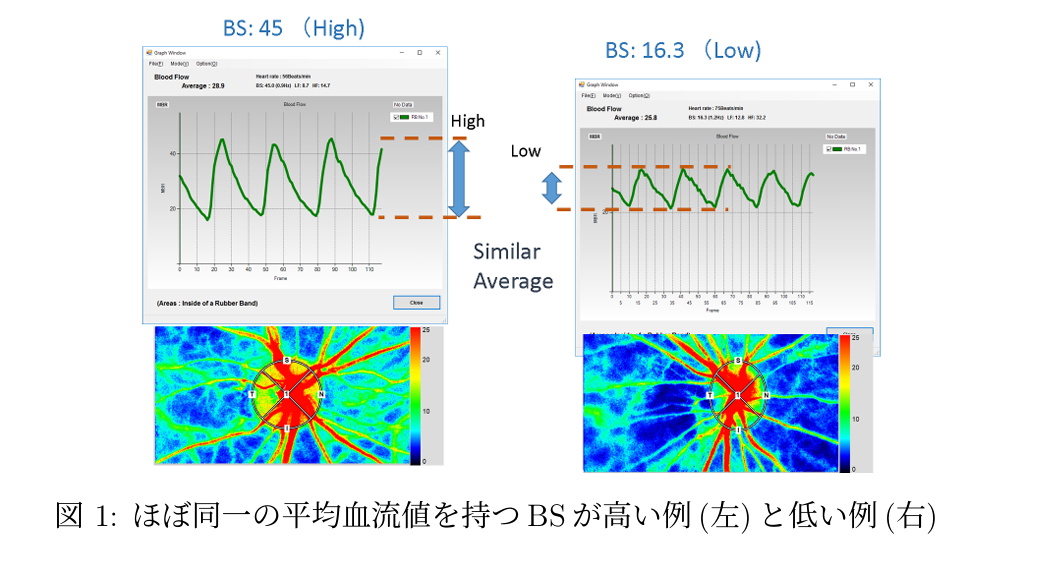
In the following example, BS of the optic nerve head is quantified for blood flow maps with similar mean blood flow values.
While there is no difference in mean blood flow values, the left example has a larger blood flow amplitude compared to the right example. To supply the same mean blood flow, the heart changes the intensity of the heartbeat to deliver blood flow to the peripheral side.
On the left side, it is necessary to increase the heartbeat intensity (BS) and amplify the amplitude, while on the right side, smoother blood flow can be supplied without increasing the load as much. The main difference between these states is the resistance caused by the vascular structure of the flow pathway and the viscosity of the blood itself. Vascular structural changes may largely be due to age-related changes. A high BS (large blood flow amplitude) indicates a state where the heartbeat intensity is increased and the load is elevated.
At sites where inflammation has occurred, it is sometimes observed that blood flow is higher than normal. However, in situations where vessels are compressed, such as with edema, the mean blood flow may not increase as much as expected, and only the blood flow amplitude may become larger. This is a situation where the load is increased in an attempt to deliver blood flow to areas suffering from nutritional insufficiency. By observing BS, the blood flow load status at the observation site can be confirmed (Reference 1). To observe the ease of blood flow, it may be useful to check the resistance. When observing resistance, BOM (= BS/MBR), which divides BS by the mean MBR, is used (Usage example: clinical report observing retinal vascular occlusion status using BOM, Reference 2).
About the Calculation Method of BS
BS does not require heartbeat detection like conventional BOS and other parameters. Instead, it uses a technique that predicts frequency distribution by applying a sparse model to perform time-frequency analysis. Among the obtained frequency distribution, the component with the maximum power is defined as BS and calculated accordingly. For detailed calculation methods, please refer to Reference 3.
Since BS does not require heartbeat detection, it is now possible to obtain BS, an objective numerical index of heartbeat intensity for blood flow dynamics, even from blood flow data where the heartbeat was unstable and waveform analysis was previously impossible. Previously, it was not possible to examine resistance parameters such as BOS in mice and rats with high heart rates, but by applying BS technology, BS and BOM calculations are now possible even in animals with high heart rates, enabling resistance studies. The BS technology can handle frequencies up to approximately 9 Hz, meaning stable BS and BOM values can be obtained for heart rates up to 540 bpm.
References
- Shinsuke Kikuchi, Keisuke Miyake, Yuki Tada, Daiki Uchida, Atsuhiro Koya, Yukihiro Saito, Takehiko Ohura and Nobuyoshi Azuma
Laser speckle flowgraphy can also be used to show dynamic changes in the blood flow of the skin of the foot after surgical revascularization.
Vascular, doi:10.1177/1708538118810664, 2018. - Ryo Tomita, Takeshi Iwase, Marie Fukami, Kensuke Goto, Eimei Ra and Hiroko Terasaki
Elevated retinal artery vascular resistance determined by novel visualized technique of laser speckle flowgraphy in branch retinal vein occlusion
Scientific Reports, 11(1), 1-11, 10.1038/s41598-021-99572-7, 2021 - Kenji Okamoto, Noriyoshi Takahashi, Tatsuhiko Kobayashi, Tomoaki Shiba, Yuichi Hori and Hitoshi Fujii
Novel superpixel method to visualize fundus blood flow resistivity in healthy adults
Scientific Reports, 13, doi:10.1038/s41598-023-33450-2, 2023.