


In a word, it is an index representing the strength of the momentum of blood flow waves.
In arteries, the blood flow momentum pumped from the heart is strong, causing the waveform to be left-skewed. On the other hand, as the momentum weakens, the waveform peak gradually recedes. The waveform that has passed through the peripheral vascular bed and returned to the veins has diminished momentum, and Skew becomes lower. The parameter that quantifies this momentum by focusing on the shape of the waveform is Skew. A higher Skew value indicates stronger momentum, while a lower value indicates a state where momentum has been lost.
For example, if blood flow is supplied to an observation point through multiple pathways, and those pathways are short, the blood flow momentum is maintained and arrives at the observation point with a high Skew. On the other hand, blood flow that has traveled a long distance through detour pathways loses its momentum and arrives with a lower Skew. Since the blood flow momentum at the observation point is quantified, it is possible to determine whether the blood flow pushed out by the heartbeat reaches the observation point with sufficient momentum.
Additionally, blood flow through collateral circulation pathways may show a high Skew even in veins, because the path length is shorter than usual.
To provide a brief technical explanation, Skew was developed as an index representing the state of systemic circulation momentum. It is a quantification of the shape of the blood flow waveform.
Skew is derived from skewness in statistics, which indicates the asymmetry of a distribution,
and its value primarily changes depending on the bias (overall shape) of the blood flow waveform.
 |
 |
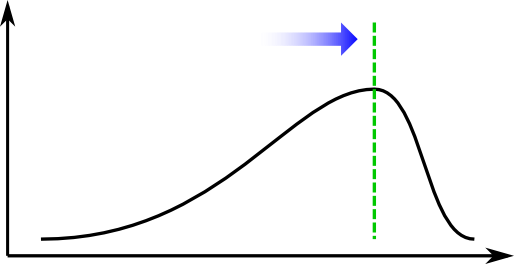 |
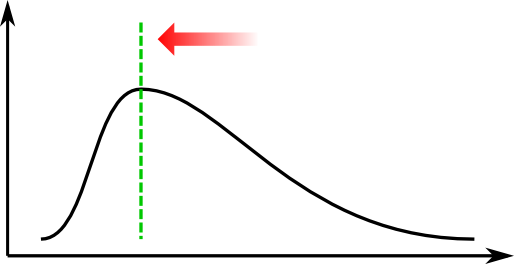
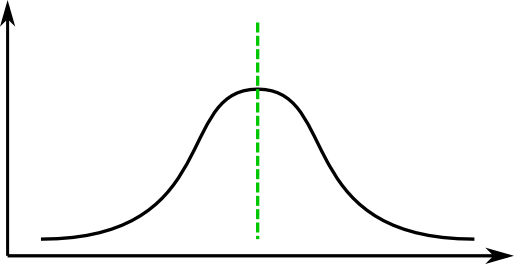
| Skew>0 | Skew=0 | Skew<0 |
When the waveform shape is symmetrical, Skew equals 0. Based on this reference, if the waveform is biased to the left, Skew takes a positive value.
Conversely, if biased to the right, Skew takes a negative value. Additionally, the greater the bias, the larger the absolute value of Skew becomes.
In arterial vessels, because blood flow rises rapidly, Skew > 0.
In venous vessels, because blood flow rises more gradually compared to arterial vessels, arterial Skew > venous Skew.
Skew also changes depending on how the waveform descends from the peak.
Even when the peak position is the same, the faster the decline from the peak, the larger the Skew becomes.
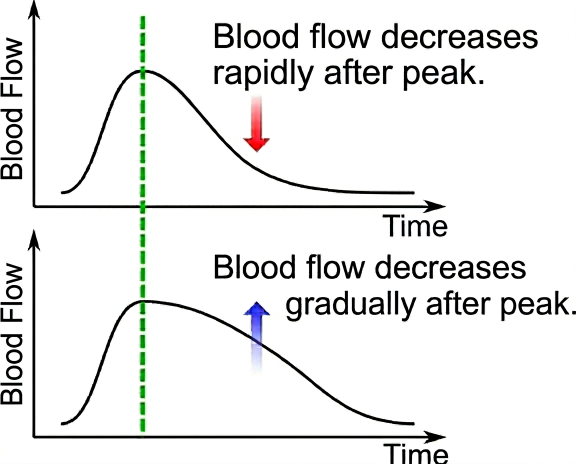 |
Skew becomes larger
|
| Skew becomes smaller |
Skew has been reported to correlate with age, with Skew increasing with advancing age.
It is considered to have potential as an index of arteriosclerosis.
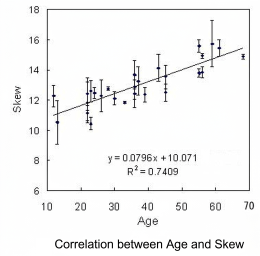
Details on the calculation method of Skew and its correlation with age are presented in the following paper.
Please refer to it.