


VC is a parameter that quantifies the degree of clarity of blood flow images. A higher value indicates that vascular outlines are more clearly visible1. It quantifies spatial contrast using a proprietary technique.
Clinical applications include CRVO and Pediatric Optic Neuritis2, among others. It can also be used as an index for identifying poor-quality LSFG images1.
- Application in CRVO
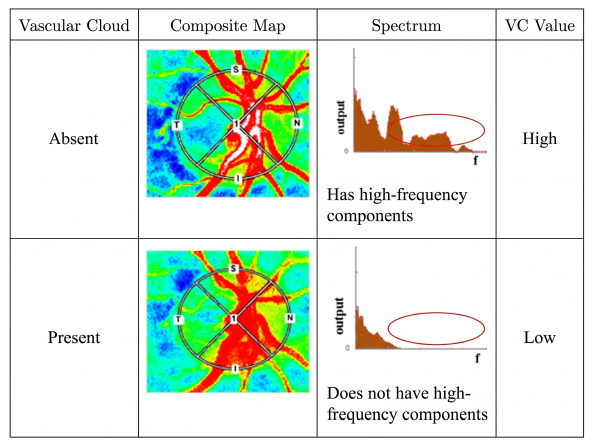
In conditions such as CRVO, collateral circulation pathways may form around the optic disc. In blood flow maps measured by LSFG, this area appears cloud-like, which is why it was named Vascular Cloud (VC).
When Vascular Cloud appears, the overall image becomes flat and featureless as shown below. Compared to cases where vascular tracings are clear, frequency analysis of a Vascular Cloud-affected image reveals that only low-frequency components are detected. By quantifying this frequency distribution, the VC value is calculated, and a higher VC value indicates clearer vasculature.
The cutoff value for VC targeting CRVO is 0.28, and it appears that there is a risk of macular edema (ME) recurrence while the VC value remains below 0.28.
- Application in Identifying Poor-Quality Images1
VC is a useful index for identifying poor-quality LSFG images and is helpful for excluding images with low acquisition quality. A higher VC indicates a clearer image.
- Healthy eyes: Cutoff 0.24 (values below 0.24 may indicate poor image quality)
- Glaucomatous eyes: Cutoff 0.28 (values below 0.28 may indicate poor image quality)
Recent Reports
- Kiyota, N. et al.
Utility of laser speckle flowgraphy-derived vascular cloud for differentiating poor image quality data.
Nippon Ganka Gakkai Zasshi127(5), 549–556 (2023). [Google Scholar] - Ryuya Hashimoto, Mizuho Oyamada and Takatoshi Maeno
Analysis of Optic Nerve Head Circulation Using Laser Speckle Flowgraphy in a Case of Pediatric Optic Neuritis
EC Ophthalmology, 9(8), 572-581, 2018.
The name Vascular Cloud was proposed by the Department of Ophthalmology, Nagasaki University Hospital, which has been actively exploring clinical applications, to make it clinically intuitive and easy to understand.
Revision: 20260310