MBR values do fluctuate due to blood pressure and pulse rate. When measuring blood flow at rest and after exercise (going up and down stairs) in the same subject, the values do indeed increase.
However, since we have not conducted a quantitative study with a large sample size (N) on the relationship between the increase in pulse rate and blood pressure and MBR values, we are unable to provide specific amounts of change.
We have investigated diurnal variation here, and although the sample was limited, we performed blood flow measurements throughout the day while simultaneously measuring blood pressure with a sphygmomanometer and pulse rate with a pulse meter.
The results showed that blood flow variation patterns differed among individuals, and there was variability in the blood pressure monitor output, so no apparent correlation with blood flow values was observed.
As for diurnal variation, blood flow values (MBR) showed fluctuations of approximately ±10% at the most variable sites and approximately ±7% at the least variable sites throughout the day.
In LSFG, blood flow values are quantified as "MBR," and these values are represented in pseudo-color (*) to create blood flow maps.
When shipping LSFG-NAVI units, we perform characteristic evaluation using our in-house calibration equipment and characteristic evaluation by actually measuring human eyes, adjusting the characteristics to meet the following standards:
- Black when scattering particles on the observation surface are stationary
- Red on the central retinal artery and vein of the fundus
- Varies linearly with the movement speed of scattering particles between these two extremes
*Definition of pseudo-color
The LSFG blood flow map displays pseudo-colors in the following order from highest to lowest blood flow value: "Red → Yellow → Yellow-green → Cyan → Blue → Black."
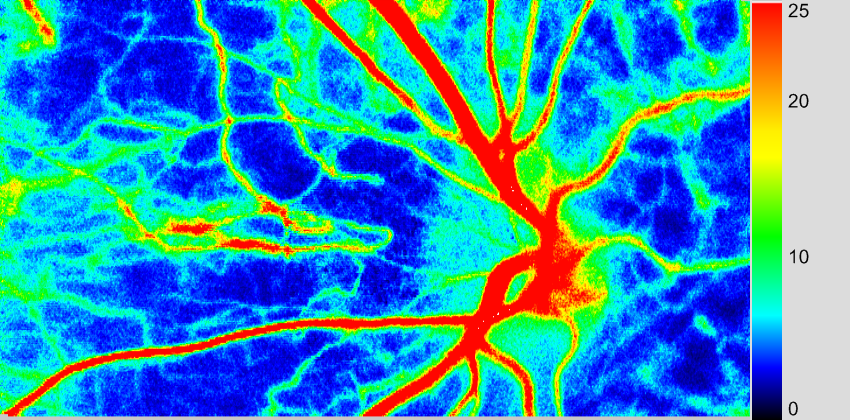
Fundus blood flow map sample (the color bar displayed on the right edge defines the pseudo-colors)